how-to
Vegetable Garden Companion Planting Guide for Beginners
Last Updated: November 7, 2026
Quick Summary
Companion planting is the practice of growing certain plants near each other so they support one another. Gardeners use it to reduce pests, share space, and make better use of their beds. Common approaches include pairing tomatoes with basil or carrots, and onions with carrots.
- Companion planting works through pest confusion, attracting beneficial insects, shared space, and nutrient balance.
- Tomatoes pair well with basil, carrots, and marigolds, but should be kept away from potatoes and fennel.
- Plant spacing should be based on mature size, not seedling size, to avoid crowding.
- Treat companion planting as a planning tool, not a guarantee, and scout plants regularly for pests.
Table of Contents
- What Companion Planting Is and How It Works
- Benefits of Companion Planting in a Vegetable Garden
- Companion Planting Chart for Common Vegetables
- Tomato Companion Planting Chart: Best and Worst Partners
- Companion Planting Carrots and Other Root Crops
- Planning Your Companion Planting Garden Layout
- Plant Pairings That Fail and How to Troubleshoot Them
- Start Your Companion Planting Plan With Herban Root and Remedy
- Frequently Asked Questions
What Companion Planting Is and How It Works
Companion planting is the practice of growing certain plants near each other so they support one another. Gardeners use it to reduce pests, share space, and make better use of their beds. Learn how seed saving lets you keep your best-performing pairings going year after year with seed-saving techniques. The idea is simple. Some plants seem to help their neighbors, and others seem to get in their way.
Many gardeners find that pairing the right crops makes a bed more productive. The science behind every pairing is not always settled. A common approach is to treat companion planting as a useful planning tool, not a guarantee. Companion planting in home gardens, University of Minnesota Extension
The practice works in a few main ways:
- Pest confusion: A strong-smelling plant can make it harder for pests to find their favorite crop.
- Attracting helpers: Flowers and herbs can draw in beneficial insects that feed on garden pests.
- Shared space: Tall plants can shade cool-season crops, and vining plants can climb on sturdy neighbors.
- Nutrient balance: Some crops use different nutrients or root depths, which can reduce competition.
Watch out: Companion planting does not solve every pest problem. Keep scouting your plants and act early when you see damage.
Benefits of Companion Planting in a Vegetable Garden
For a beginner, the biggest benefit is a garden that works with itself. A well-planned bed can use less space, need fewer chemical controls, and produce more across the season.
Here are the most common benefits gardeners report:
- Fewer pest problems in some pairings
- Better use of limited bed space
- More flowers that bring in pollinators
- A garden that feels more balanced and easier to manage
Gardeners who want to dig deeper can review the research on individual pairings. Gardening with Companion Plants, Washington State University Extension The published guidance is clear that results vary by climate, soil, and garden setup.
Companion Planting Chart for Common Vegetables
This chart lists common pairings that many gardeners use as a starting point. Each row carries a confidence label so you can tell well-supported effects from traditional advice. Treat the labels as a guide to how much weight to give a pairing, not as a guarantee.
- Well-supported: Backed by extension guidance or widely observed mechanisms such as pest confusion, trap cropping, or root-zone separation.
- Traditional: Long-standing garden practice with limited formal study; worth trying, but watch your own results.
- Anecdotal: Reported by gardeners but not consistently reproduced; test on a small scale first.
| Vegetable | Good Companions | Avoid Planting Near | Main Reason | Confidence |
|---|---|---|---|---|
| Tomatoes | Basil, carrots, marigolds | Potatoes, fennel | Basil scent may mask the crop; carrots use a different root zone; potatoes share blight and pests; fennel is allelopathic | Traditional (basil, marigolds); Well-supported (potatoes, fennel) |
| Carrots | Onions, leeks, rosemary | Dill, parsnips | Allium scent can confuse carrot fly; dill and parsnips share pests and root space | Traditional (onion family); Well-supported (dill, parsnips) |
| Beans and peas | Corn, cucumbers, radishes | Onions, garlic | Legumes fix nitrogen; corn gives climbing support; alliums can suppress legume growth | Well-supported (corn, alliums); Traditional (cucumbers, radishes) |
| Squash | Corn, nasturtiums | Potatoes | Corn shares space and shade; nasturtiums act as a trap crop for aphids; potatoes compete for water and nutrients | Traditional |
| Cabbage and brassicas | Onions, thyme, dill | Strawberries, tomatoes | Strong-scented neighbors can deter cabbage worm and flea beetle; strawberries and tomatoes compete for water and share some soil issues | Traditional (onions, thyme); Anecdotal (dill) |
| Cucumbers | Beans, peas, radishes, nasturtiums | Aromatic herbs such as sage | Legumes fix nitrogen; radishes mark rows and use space early; strong herbs may inhibit growth | Traditional |
| Onions and alliums | Carrots, beets, lettuce | Beans, peas | Alliums deter carrot fly; legumes are suppressed by allium compounds | Well-supported (legumes); Traditional (carrots) |
| Lettuce and leafy greens | Carrots, radishes, onions | Tall, vining crops | Shallow roots use different zones; tall crops shade lettuce and slow bolting | Well-supported (shade effect); Traditional (onions) |
Treat this chart as a starting list. Adjust it based on your own space, your climate, and what you see in your garden. A pairing labeled traditional may work beautifully in your beds and fail in a neighbor's, because pest pressure, soil, and season all shift the outcome.
Tomato Companion Planting Chart: Best and Worst Partners
Tomatoes are one of the most popular crops for companion planting, and they pair well with several herbs and flowers.
Best partners:
- Basil, which many gardeners plant beside tomatoes for its scent and easy harvest
- Carrots, which grow in a different root zone
- Marigolds, often planted for their flowers and pest-deterring reputation
Worst partners:
- Potatoes, which share pests and diseases
- Fennel, which can stunt tomato growth
Plan tomato spacing with mature size in mind. Crowded plants compete for light and airflow.
Companion Planting Carrots and Other Root Crops
Carrots grow well with onions, leeks, and rosemary. For a root crop that pairs well alongside them, follow our step-by-step garlic growing guide. The strong smell of onions and leeks can help confuse carrot flies. Keep carrots away from dill and parsnips, which share some pests.
Other root crops follow similar rules. Radishes can be planted between slow-growing crops to make use of space. Harvest radishes early so they do not crowd their neighbors.
Planning Your Companion Planting Garden Layout
A good layout is the key to success. Start by sketching your beds on paper. Mark where the sun falls and where tall plants will cast shade.
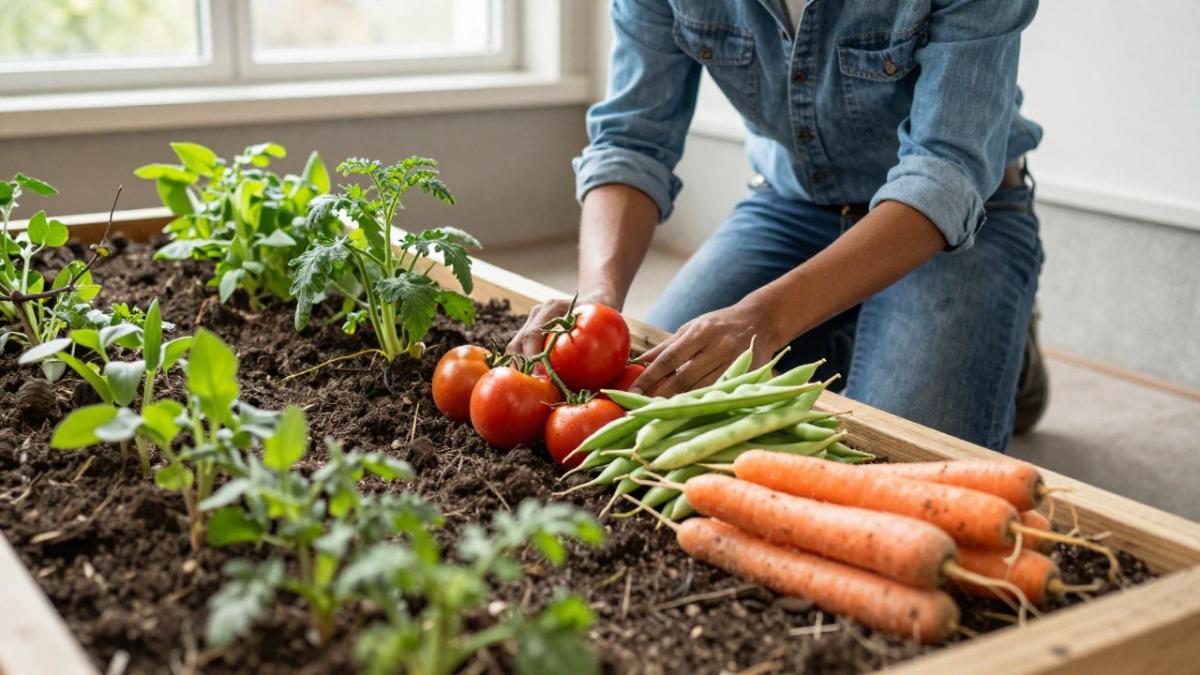
A gardener kneeling beside raised beds of mixed vegetables, with tomatoes, carrots, and bush beans growing in neighboring rows under morning light, shows this approach in practice.
Follow these steps:
- Measure your bed and mark the sunny and shady areas. Note how many hours of direct sun each zone receives.
- Place tall crops like corn and tomatoes on the north side so they do not shade shorter plants.
- Group companions in blocks rather than single plants, so beneficial insects can find them and roots share space evenly.
- Leave walking paths wide enough to reach every plant for harvest without stepping on beds.
- Plan spacing at mature size, not seedling size, so neighbors do not crowd each other by midsummer.
Spacing at mature size. Companion planting fails most often when plants are set too close. Use mature spread, not nursery-pot size, when you space crops:
- Tomatoes: about 24 to 36 inches apart, with staking or caging to keep foliage off the ground.
- Bush beans: about 6 to 12 inches apart in rows 18 to 24 inches apart.
- Carrots: about 2 to 3 inches apart in rows 12 inches apart; thin seedlings early.
- Lettuce: about 6 to 12 inches apart, depending on variety.
- Corn: about 12 inches apart in blocks of at least four rows for pollination.
- Cucumbers: about 12 to 18 inches apart if trellised, more if allowed to sprawl.
Watch out: Close planting shades lower leaves, reduces airflow, and increases disease pressure. If leaves stay wet and lower foliage yellows, thin the bed before problems spread.
Timing and succession. Coordinate crops with different maturity dates so a fast crop finishes before a slow neighbor needs the space:
- Sow radishes and lettuce between rows of slow crops like carrots or brassicas; harvest the fast crop in four to six weeks.
- Follow early peas with beans or cucumbers once soil warms.
- Set transplants of warm-season crops like tomatoes and peppers after the last frost date for your area, and direct-sow beans and corn when soil is reliably warm.
- In short-season climates, choose faster-maturing varieties and start warm-season crops indoors to fit the window.
Small-space and container combinations. Balcony and raised-bed gardeners can still use companion planting, but soil volume limits what works:
- Pair compact herbs like basil with a single tomato in a large container.
- Grow lettuce and radishes together in shallow boxes; harvest radishes before lettuce needs the space.
- Use trellised cucumbers or peas to add vertical space without crowding the soil surface.
- Avoid pairing two heavy feeders in one small container; they compete for the same limited water and nutrients.
For new gardeners, our guide on how to start a vegetable garden for beginners covers bed design, soil, and planting times to pair with your companion plan.
Plant Pairings That Fail and How to Troubleshoot Them
Not every pairing will work in your garden. If a pairing seems to struggle, check these common causes:
- Plants are crowded and competing for water or light
- The soil is poor or unevenly watered
- Pests have already settled in before the companion plant arrived
- The climate or season does not suit the pairing
Adjust spacing first. If problems continue, move one plant to a new bed and watch it for a full season. Many gardeners find that a small change makes a big difference. To add a pollinator-friendly herb to a struggling bed, see our guide to growing yarrow.
Start Your Companion Planting Plan With Herban Root and Remedy
At Herban Root and Remedy, we believe a companion planting plan works best when it fits your land, your climate, and your family's needs. Our digital guides include seasonal planting calendars and step-by-step gardening instructions, so you can grow with confidence. Start with one bed, track what works, and expand each season.
Frequently Asked Questions
What vegetables are best to plant beside each other?
Tomatoes grow well beside basil, carrots, onions and parsley, and beans pair well with carrots, cucumbers and squash. These pairings work because the plants occupy different root depths or heights and do not compete heavily for the same nutrients. Check the companion planting chart in this guide for crop-by-crop pairings, and note that the strength of each pairing varies with climate and garden layout. Start with two or three combinations in one bed to see how they perform in your own soil before expanding.
Does companion planting really work in a vegetable garden?
Companion planting is discussed in university extension guidance as a practice that some gardeners use for crop diversity and pest management. Research on individual pairings is limited, however, and companion planting should not be treated as a guaranteed solution to pest problems. Treat it as one tool alongside good spacing, crop rotation and healthy soil, and keep notes on what works in your garden.
What veggies should not be planted next to each other?
Some vegetables are commonly advised to stay apart because they compete for the same nutrients or attract similar pests, and onions and beans are often cited as an example of a pairing to avoid. Keep crops in the same plant family separated where possible to slow the spread of soil-borne disease.
Can carrots and onions be planted together?
Carrots and onions are a common companion pairing because onion scent is often said to help deter carrot flies, although the evidence for this effect is modest. Plant them in alternating rows or interplanted within the same bed, and give each crop enough spacing for its mature size. The carrots section of this guide covers spacing and root competition in more detail.
